
Betting explained
Odds Converter and What Betting Odds Mean
An odds converter turns the same price between the three notations bookmakers use, and tells you the one thing the price is really saying, which is how often a selection has to win before the bet stops losing money. Type a price into any box below and the rest follow.
 By
By
Convert any price
Enter a price in whatever notation you have it in. The other three update as you type, along with what a ten pound bet returns and the strike rate you would need to break even at that price.
Odds converter
Type into any box. The other three follow. Fractional accepts 11/10 or evens.
UK bookmaker format
Exchange and European format
Moneyline
Per cent, margin included
Implied probability is what the price charges you for, not what the outcome is worth. It already carries the bookmaker margin, which is why every price in a real market adds up to more than 100 per cent.
What a price is actually telling you
Every betting price is a probability with a business model wrapped round it. Divide one by the decimal price and you get the implied probability: the chance the price is charging you for. At 2.00 that is 50 per cent, at 4.00 it is 25 per cent, at 1.25 it is 80 per cent.
That number is also your break-even strike rate. A price of 2.00 needs to win half the time before it makes a penny. A price of 1.25 needs to win four times in five. Long prices look attractive because the return is large; they are also telling you they expect to be wrong most of the time.
Read any price in three steps
The same three steps work on every notation, and they are the whole of what a converter does.
-
Get it into decimal
Fraction: divide the left by the right and add one. American plus: divide by 100 and add one. American minus: divide 100 by it and add one. Decimal is the only format that compares and multiplies cleanly.
-
Divide one by it
That is the implied probability, and it is also the strike rate the price needs before it breaks even. 2.50 gives 0.40, so 40 per cent.
-
Ask whether the outcome is likelier than that
This is the only step that requires you, and no tool does it. If you think the outcome happens more often than the price implies, the price is worth taking. If not, the return is irrelevant.
Fractional odds, and what odds on really means
British bookmakers quote fractions. The number on the left is what you win, the number on the right is what you stake, so 6/4 wins six for every four risked and returns ten in total. The convention survives because racing has used it for two centuries, not because it is convenient.
A price with the larger number on the left is odds against, and pays more than your stake. The other way round is odds on, and pays less. Evens sits exactly between them and is written 1/1. Fractions become awkward the moment you need to compare them, which is why 100/30 exists at all and why nobody can say at a glance whether 15/8 beats 2/1. Racing carries its own conventions on top, including the place fractions on an each way bet.
Decimal odds, and why exchanges prefer them
A decimal price is the total return on a one unit stake, stake included. 6/4 becomes 2.50, evens becomes 2.00, 1/2 becomes 1.50. The conversion is the fraction as a division plus one, and the plus one is the stake coming back.
Exchanges and most of Europe use decimals for one practical reason. They multiply. Three legs at 2.50, 3.00 and 1.80 are 13.50 in one step, and doing that in fractions is a chore nobody attempts twice. That multiplication is exactly what an accumulator is. It is also why every calculator, including our bet return calculator, works in decimals underneath whatever you typed in.

American odds and the plus or minus sign
American odds count outwards from even money in both directions, which is why they carry a sign. A minus price is the stake needed to win 100, so -200 means risk 200 to win 100. A plus price is the profit from a 100 stake, so +150 means win 150 from 100.
Even money is the hinge and is written +100. Anything between -100 and +100 does not exist. You will meet the format on American sportsbooks and in the People Also Ask box on this very search, which is why it is here even though no British book quotes it.

The prices you will meet most often
| 1/4 · 1.25 · -400 | 80% implied. A heavy favourite. Four wins in five just to stand still. |
|---|---|
| 1/2 · 1.50 · -200 | 66.7% implied. Two in three. |
| 4/5 · 1.80 · -125 | 55.6% implied. The common price on a short favourite in a two-way market. |
| Evens · 2.00 · +100 | 50% implied. The hinge of every format. |
| 6/4 · 2.50 · +150 | 40% implied. Two wins in five. |
| 2/1 · 3.00 · +200 | 33.3% implied. One in three. |
| 100/30 · 4.33 · +333 | 23.1% implied. Racing shorthand for a shade over 3/1, and the clearest argument for decimals. |
| 10/1 · 11.00 · +1000 | 9.1% implied. Once in eleven. |
What each price needs you to be right about
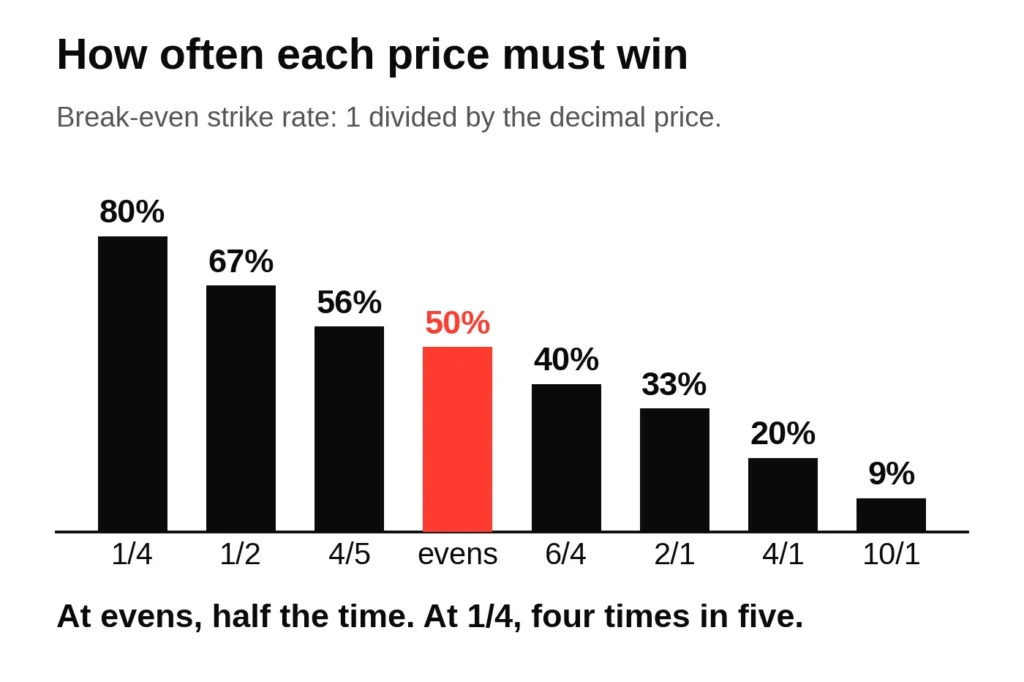
Put those break-even rates side by side and the shape of the thing becomes obvious. The price is not a prediction, it is a bar you have to clear, and it gets lower as the price gets longer.
This is the number to check against your own record rather than against your instinct. If you back short favourites at 1.25 you need to be right four times in five, forever, and a run of three losers in twenty bets is enough to put you underwater for the season.
Why the price moves, and what the move tells you
Prices are not fixed, and the direction of travel carries information the number alone does not. A price that shortens has been backed, and the book has moved it to protect itself. A price that drifts has not, or something has come out about the selection since the market opened. Books that price for themselves move at different moments, which is why the shared-feed test on the betting sites page works.
The price at the moment a market settles is the sharpest number anyone will produce on that event, because it has absorbed everything every customer knew. That is why beating it consistently is the behaviour bookmakers watch for most closely, and it is the reason a customer who takes 5.00 about something that starts at 4.00 gets noticed long before they have won anything. We go through what follows from that on our page about why bookmakers limit and close accounts.
The vocabulary you will hear around a moving price
| Shortening, or coming in | The price is getting smaller because money has arrived. 3/1 into 5/2. |
|---|---|
| Drifting, or going out | The price is getting bigger because it has not. 3/1 out to 4/1. |
| Steamer | A selection that shortens sharply and early, usually on sustained support rather than one large bet. |
| Starting price, or SP | The price at the off in racing, set from the on-course market. Bets can be struck at SP rather than a taken price. |
| Closing line | The final price before an event starts. The most accurate number the market produces, and the benchmark a trading desk measures you against. |
What counts as good odds
Two of the three competitors ranking for this term answer the question “what are good odds”, and both answer it badly, because the honest answer is that no price is good or bad on its own. A price is good when the outcome happens more often than the price implies, and bad when it does not, and that comparison is a judgement about the event rather than a property of the number.
What can be said without judging anything is which of two prices on the same selection is better, and that is worth more than it sounds. Two books quoting the same match will not quote the same price, and the gap between the best and worst available number on an outcome is routinely larger than the margin either book is charging. Converting both to decimal takes a second and is the only way to see it.
What the implied probability does not tell you
Here is the part a converter cannot do for you. Implied probability is not the chance of the outcome happening. It is the chance the price is charging you for, and it already has the bookmaker margin folded into it.
Add up the implied probabilities of every outcome in a real market and the total comes to more than 100 per cent. The overshoot is the margin, and across 50 Premier League fixtures we measured it at 6.13 per cent on the match result. So a price implying 50 per cent is really offering you something nearer 47, and the gap is the book. The arithmetic, and what it costs over a season, is on our page about the margin built into a price.

Betting odds questions answered
Win 200 from a 100 stake, so a total return of 300. In decimal that is 3.00 and in fractions 2/1. The implied probability is 33.3 per cent, which is also the strike rate the price needs to break even.
11/2 wins eleven for every two staked. A 10 pound bet returns 65 pounds, 55 of it profit. Decimal 6.50, American +550, implied probability 15.4 per cent.
It marks which side of even money a price sits. Minus is a favourite and tells you the stake needed to win 100. Plus is an underdog and tells you the profit from a 100 stake. There is nothing between -100 and +100 because that gap is even money itself.
British books quote fractions: left is profit, right is stake. Convert to decimal by dividing and adding one, and the price becomes a total return you can compare and multiply. Almost every British site will also let you switch the display to decimal in its settings.
Decimal, for anything you intend to compare or combine. Fractions hide small differences, which is the point of prices like 15/8 and 100/30, and they cannot be multiplied across a multiple without converting first.
No. Short odds mean the price expects the outcome more often, and it demands a matching strike rate from you. At 1.25 you need to win four times in five. A price is only good relative to how likely the outcome actually is, which is a judgement no converter can make.
One divided by the decimal price, expressed as a percentage. It is what the price is charging you for rather than what the outcome is worth, because the bookmaker margin is already inside it. Every real market totals more than 100 per cent once you add all the outcomes up.
Because each book prices its own market and each takes its own margin. The differences look small in fractions and are not small over a season. Converting both to decimal before you choose is the only reliable way to see which is actually better.