 By
By
Top Choice
1

Gamble Gorilla
- Exclusive Free Bet Offer
- In-Play Live Betting
- Broad Sports Coverage
Bonus
WELCOME SPORTS FREEBET
UP TO £100
FREEBET
UP TO £100
FREEBET

Boxing
Boxing betting is one fight, one night and a handful of markets that each price the same bout a different way, so knowing which market fits your opinion matters more than anything else. We worked through the arithmetic of short-priced favourites, method of victory and round betting, and ranked books on price, market depth, settlement rules and how they treat a winning account.














Every book prices the main event. The differences show up in the side markets, the undercard and the small print, which is where the books differ. The tests every book faces, whatever the sport, are set out on our page about online betting sites.
In Britain the standard boxing market has three outcomes: either fighter wins, or the fight is a draw. A draw on the scorecards is rare but real, and when it happens a bet on either fighter loses. That is why the draw is priced as a runner in its own right, usually at long odds, and why it shortens when two evenly matched fighters look likely to go the distance.
Some books offer the fight as a two-way market with the stake returned on a draw, the boxing version of reading a draw no bet price. It pays slightly less than the straight fight winner price because the draw has been taken out. If you are backing an outsider in a close fight that could go to the cards, the refund is worth the shorter price; on a heavy favourite it rarely matters.
Big boxing nights often feature a champion at 1/5 or shorter. The price looks safe, but the arithmetic is unforgiving: one upset costs you the winnings of many successful bets.

Method of victory asks how the fight ends as well as who wins it. Inside the distance covers a knockout, a stoppage or a disqualification; on points means the fight goes to the scorecards.
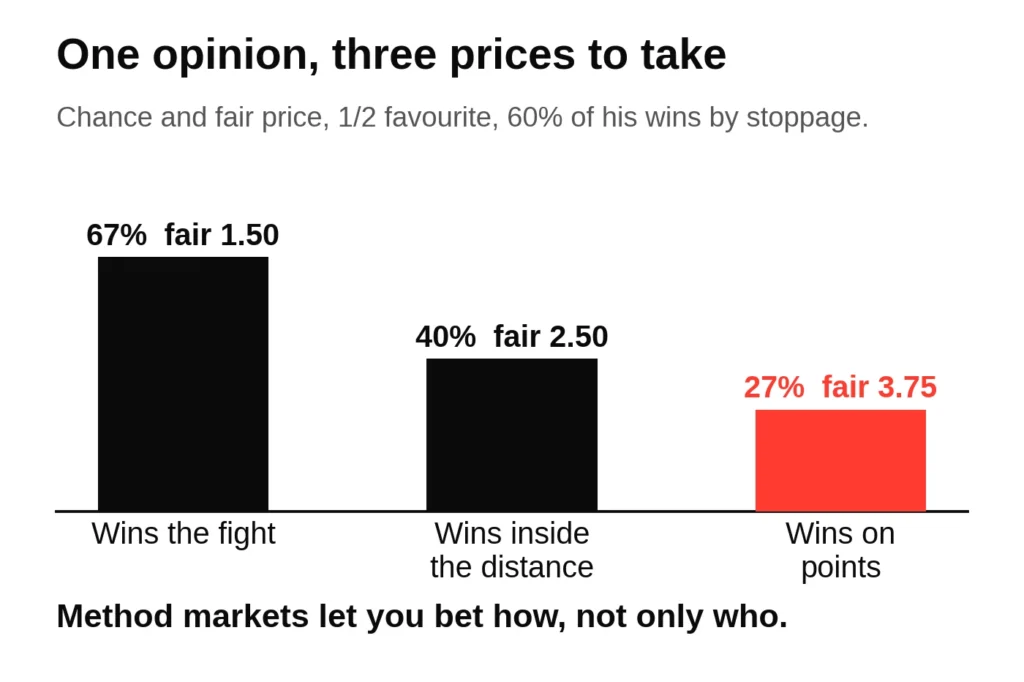
A fight winner price bundles two outcomes, a stoppage and a decision. If you know how a fighter usually wins, you can split the price and take the part you believe in. Take a fighter at 1/2, a 66.7 per cent chance, whose wins come inside the distance 60 per cent of the time.
Every method price carries a wider margin than the fight winner market, so the split only pays when your read of the fighter differs from the book’s.
Round betting narrows the method bet to the round the fight ends in. It pays long prices because it is hard to hit, and the grouped version trades some of the price for a wider target.

Boxing books settle round totals on the clock. Half a round is a minute and a half of a three-minute round, so over 7.5 rounds wins only if the fight passes 1 minute 30 seconds of round 8. A stoppage 40 seconds into round 8 is under. The same rule applies to every half-round line, and it catches out anyone who reads the line as whole rounds.
Boxing produces more unusual endings than most sports, and settlement rules decide what they pay. These are the common cases and how most books treat them; the detail varies, so read the rules before a big bet.
| Draw on the scorecards | Bets on either fighter lose; the draw wins; draw no bet stakes are returned |
|---|---|
| Technical decision | A fight stopped by an accidental foul after the set number of rounds goes to the cards and settles as a points win |
| Disqualification | Usually counted as inside the distance for method of victory |
| Fight cancelled or opponent replaced | Bets are void and stakes returned |
| Scheduled rounds changed | Round and total-rounds bets are void; fight winner bets usually stand |
| Result overturned later | Most books settle on the result announced in the ring and ignore later changes |
Three judges score every round, usually ten points to the winner of the round and nine or fewer to the loser. The decision is unanimous if all three agree, split if one disagrees, and a majority if one scores it level.
Boxing is an awkward sport for betting in play. A round lasts three minutes and the fighters rest for one, and many books only reopen the market in that minute between rounds.
Most boxing prices are set weeks ahead and move in the final days as news comes out. The moves are often bigger than in team sports because one person decides the result.
How fights end depends heavily on the weight class. Heavier fighters end more fights inside the distance, and the lighter divisions go to the scorecards more often.
The main event takes most of the money and gets the keenest price. The undercard, four to eight fights before it, is priced with less attention and can be where the value sits.
Stacking favourites from one card is a popular way to bet a boxing night, because each price on its own pays so little. Each selection carries its own margin, so the cost grows with every fight added, and one upset beats the whole bet. Before you place a multiple, run it through the bet calculator to see the return; it shows how little a treble of 1/5 shots actually pays.
Most boxing predictions are opinions about who is better. The factors that change a price before the market catches up are more specific.
Boxing is a thin market outside the biggest fights, and books take small stakes on it. An account that keeps finding value on undercard fights or round markets is limited quickly; our guide to how bookmakers limit accounts explains why.
A UK-licensed book must also verify you before your first bet and check your finances once net deposits pass 150 pounds in 30 days. Offshore books licensed outside Great Britain ask for far less up front and have a reason to keep a winning boxing account open.
Which book suits you depends on the kind of boxing bet you place.
Choose a fight and a market, such as the fight winner, method of victory, round betting or whether the fight goes the distance, and place the bet before the first bell or between rounds.
The one with a low margin on the fight winner, deep method and round markets on the whole card, clear settlement rules and a record of keeping winning accounts open. The ranking at the top of this page is built on those.
A bet on either fighter loses and a bet on the draw wins. If you took draw no bet, your stake is returned.
A bet on how the winner wins: inside the distance, meaning a knockout, stoppage or disqualification, or on points after the scheduled rounds.
You back a fighter to win in a specific round, or in a group of rounds such as 1 to 3. The bet wins only if the fight ends in that round or group.
Bets on the original fight are void and stakes are returned. The new fight is priced as a new market.
Multiply your stake by the decimal odds for the total return. A 10 pound bet at 1/5, or 1.20, returns 12 pounds, 2 pounds of it profit.
Yes. Most books price the fight in play, usually reopening the market in the minute between rounds.