
18+ Betting can harm. Stop, take a breath, think before you bet.

Cricket

Cricket Betting Sites UK 2026, Ranked on Price

Cricket betting is cheap on the match and expensive almost everywhere else, so the book you use and the market you pick matter more than any tip. We read the prices at every book on 13 cricket markets, from one-day internationals to the next Ashes and the top batsman, and ranked books on price, depth, settlement rules and how they treat a winning account.

Avatar photo By Tom Lunn Updated Fact-checked by Tom Lunn
Cricket betting: stumps on an empty pitch with a red cricket ball on the crease

Top cricket betting sites for UK punters 2026

Bet Bluff
9.8 (9.8/10)
  • Exclusive Free Bet Deal
  • Smart Bet Builder
  • Fast Cash-Out
Bonus
EXCLUSIVE WELCOME SPORTS FREEBET
Bet £25 +
Get £50 Freebet!
Spinny Casino
9.5 (9.5/10)
  • Dedicated Sports Welcome Bonus
  • High-Yield Odds
  • Quick & Secure Payouts
Bonus
WELCOME SPORTS FREEBET
UP TO £100
FREEBET
Wettson
9.3 (9.3/10)
  • Exclusive Free Bet Promo
  • Live Match Statistics
  • Flexible Payments
Bonus
EXCLUSIVE WELCOME SPORTS FREEBET
Bet £25 +
Get £50 Freebet
GladiatorsBet
9.2 (9.2/10)
  • Exclusive Free Bet Package
  • Boosted Combat & Football Odds
  • Action-Packed Live Console
Bonus
EXCLUSIVE WELCOME SPORTS FREEBET
Bet £25 +
Get £50 Freebet!
Fiesta Slots
9.0 (9.0/10)
  • Exclusive Free Bet Voucher
  • Extensive Global Markets
  • Mobile-Optimized Interface
Bonus
EXCLUSIVE WELCOME SPORTS FREEBET
Bet £25 +
Get £50 Freebet!
Roibets
8.9 (8.9/10)
  • Default Welcome Free Bet
  • Accumulator Odds Boosts
  • Comprehensive In-Play Hub
Bonus
WELCOME SPORTS FREEBET
UP TO £100
FREEBET
Lolo Casino
8.5 (8.5/10)
  • Dedicated Sports Welcome Offer
  • Top Football Odds
  • Streamlined Registration
Bonus
WELCOME SPORTS FREEBET
UP TO £100
FREEBET
Froggybet
8.4 (8.4/10)
  • Dynamic Live Betting
  • All-In-One Sportsbook
  • Intuitive Navigation
Bonus
100% Welcome Sports Freebet
Emberbet
8.1 (8.1/10)
  • Exclusive Free Bet Incentive
  • Hot Odds Boosts
  • Instant Cash-Out Control
Bonus
EXCLUSIVE WELCOME SPORTS FREEBET
Bet £25 +
Get £50 Freebet!
Reel Raven
8.1 (8.1/10)
  • Exclusive Free Bet Deal
  • Custom Bet Builder
  • 24/7 Live Markets
Bonus
EXCLUSIVE WELCOME SPORTS FREEBET
Bet £25 +
Get £50 Freebet!
Luck Leopard
7.7 (7.7/10)
  • Exclusive Free Bet Bonus
  • Extensive Horse & Football Coverage
  • Fast Cashouts
Bonus
EXCLUSIVE WELCOME SPORTS FREEBET
Bet £25 +
Get £50 Freebet!
JasminSlots
7.5 (7.5/10)
  • Special Sports Welcome Package
  • Competitive Market Odds
  • Fast Account Verification
Bonus
EXCLUSIVE WELCOME SPORTS FREEBET
Bet £25 +
Get £50 Freebet
Andromedasino
7.2 (7.2/10)
  • Exclusive Free Bet Sign-Up
  • Interactive Live Match Stats
  • Top-Tier Odds
Bonus
EXCLUSIVE WELCOME SPORTS FREEBET
Bet £25 +
Get £50 Freebet!

What we test at a cricket book

A cricket match can run for three hours or five days, and the markets change with the format. We price the match first, then the markets around it, then the rules and the account behaviour that decide whether a winning bet is paid and whether the next one is accepted.

  • Match odds margin: the whole market at each book, on one-day, T20 and Test cricket
  • Market depth: top batsman and bowler, innings runs, sixes, partnerships and method of dismissal
  • Settlement rules: ties, super overs, rain-reduced games, abandoned matches and the draw
  • In-play: how quickly the book reopens after each ball and how often it suspends
  • Limits: how the book treats a cricket account that wins, especially on player markets

What a cricket bet costs you

We read every price on 13 cricket markets between 28 and 30 September 2026, at every book that priced the whole market, and added up the chance each price implies. A fair market totals 100 per cent; everything above that is the margin you pay.

The match itself is keenly priced. A two-way one-day international ran at about 106 per cent at the typical book, a T20 match at about 106.5. Move away from the match and the margin climbs fast: a tournament winner costs three to four times as much, and the top batsman market costs ten times as much.
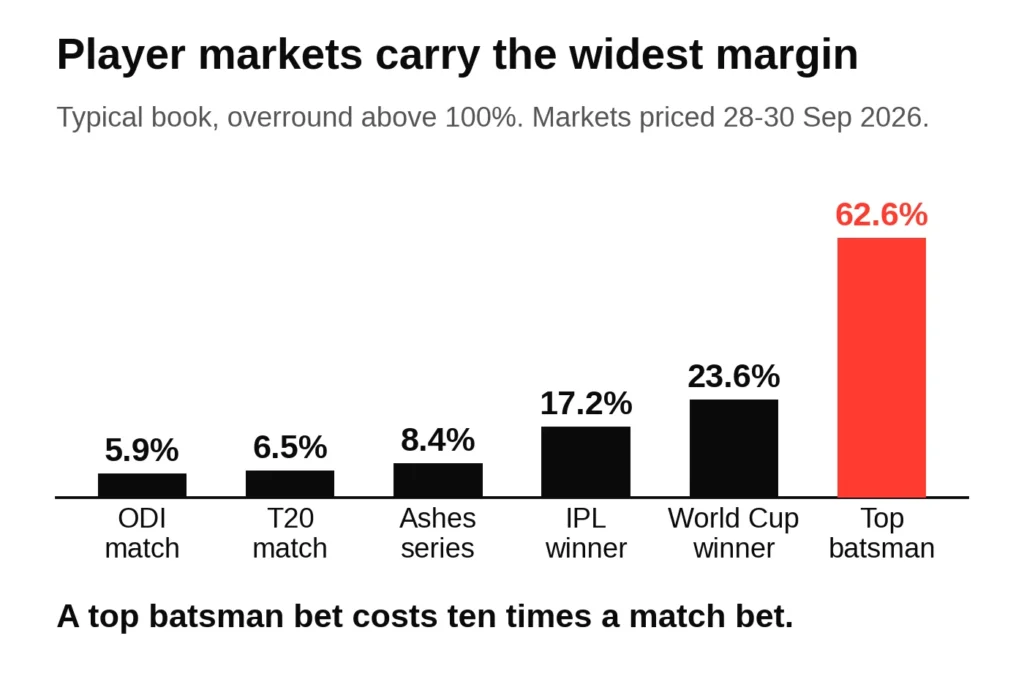
  • One-day international match winner: 104.3 to 109.4 per cent across 19 to 21 books
  • T20 match winner: 104.1 to 110.5 per cent across 10 to 16 books
  • The Ashes series, England, Australia or the draw: 106.3 to 111.9 per cent across 12 books
  • Top batsman: 157.5 to 171.4 per cent at the few books that priced every player
Chart of cricket betting margin by market, from about 6 per cent on a match to 62.6 per cent on top batsman
Overround above 100 per cent at the typical book, 28 to 30 September 2026: two ODIs (19 and 21 books), four CSA T20 Challenge matches (10 to 16 books), the Ashes series (12), IPL winner (13), ODI World Cup winner (15), top batsman in South Africa v Australia (3 books). Exchanges excluded.

Why player markets are so wide

A top batsman market lists 30 or more players, and only one of them can win it. The book shades every price a little shorter than its real chance, and a few points taken off each of 30 players adds up to more than half the market. The overround works the same way on any market with many runners; cricket simply puts a match priced at 6 per cent next to a player market priced at 60.

How much the best price saves on cricket

Books agree on the favourite and disagree on everything else. Taking the longest price on each side, wherever it was, turned markets that cost 9 to 12 per cent at the widest book into ones that cost under 3 per cent, on the three markets in the chart. On the Ashes the best prices across 12 books added up to just 100.8 per cent, close to a fair market.
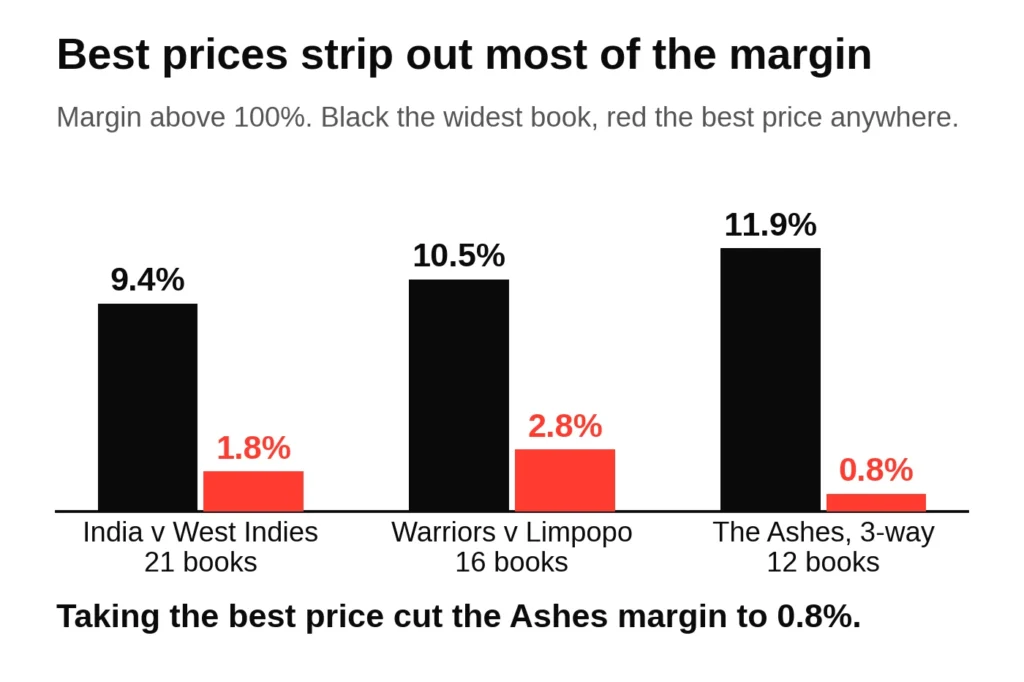
Chart comparing the widest bookmaker with the best price across books on three cricket markets
Overround above 100 per cent at the widest single book against the best price on each selection at any book, 28 to 30 September 2026. India v West Indies (21 books), Warriors v Limpopo, CSA T20 Challenge (16), the Ashes series (12). Exchanges excluded.

Heavy favourites and the outsider price

Most of the gap sits on the outsider. In India against West Indies every book had India between 1/25 and 1/9, a spread of a few pence on a winning pound. West Indies ranged from 5/1 to 15/2.

  • A 10 pound bet on West Indies returned 60 pounds at the shortest book and 85 pounds at the longest
  • On Warriors against Limpopo the outsider ranged from 4.20 to 5.50 in decimal odds
  • The Ashes draw ranged from 5/1 to 13/2 across 12 books

If you back outsiders, and the draw in Test cricket is usually one, the book you use decides more of your return than your opinion does.

Test match betting and the draw

A Test runs for up to five days and has three results: either side wins, or the match is drawn when time runs out before a result. That third outcome makes Test match odds a three-way market, like a football match, and it moves more than any other price in cricket.

  • Rain and bad light shorten the draw, because lost overs cannot be made up
  • A flat pitch that suits batting shortens the draw; a pitch that turns or seams lengthens it
  • County Championship matches run over four days and end drawn more often than Tests
  • Once a result looks likely the draw drifts quickly, which is where much of the in-play money goes
Illustration of cricket stumps with one red bail, for Test match betting and the draw
Illustration: stumps and bails. A Test match has three results, and the draw is priced as a runner in its own right.

Draw no bet and the tied Test

If you think a side will not lose but are not sure it will win, draw no bet backs it with the stake returned if the match is drawn, at a shorter price than the straight win. A tie is something else: both sides finish level on runs with the last batter out. It has happened twice in more than 2,500 Tests, and most books settle a tied Test by dead heat rules, paying half the stake on each side at full odds and settling draw bets as losers.

One-day, T20 and The Hundred

Limited-overs cricket always produces a winner or a tie, so match betting is a two-way market with a much lower margin than a Test. The shorter the format, the less the favourite can control, and prices in T20 and The Hundred sit closer together than in one-day cricket.

  • One-day internationals: 50 overs a side, the strongest favourites and the deepest player markets
  • T20: 20 overs a side, the IPL, the T20 Blast and the T20 World Cup
  • The Hundred: 100 balls a side, played in England in July and August
  • Night matches: dew makes the ball harder to grip in the second innings, which helps the side batting second

The toss matters more in short cricket than in long. A side that chooses to chase knows its target, and on a dewy evening the chasing side is often shorter in the market before a ball is bowled.

Rain, ties and abandoned matches

Cricket is the one major sport where the weather can decide the result, change the target or end the match with no result at all. Settlement rules differ between books in the detail, so these are the common cases and how most books treat them.

Illustration of an umbrella over the crease, for how rain and abandoned matches settle cricket bets
Illustration: an umbrella over the crease. Rain can shorten a match, change the target or leave no result.

How the common cricket results settle

Rain-reduced limited-overs match

Settled on the official result, including a target revised by the Duckworth-Lewis-Stern method

Tie decided by a super over

Most books settle match bets on the super over winner, where the competition uses one

Tie with no super over

Dead heat rules: half the stake on each side at full odds

Abandoned with no result

Match bets are void and stakes returned

Drawn Test or first-class match

Player bets such as top batsman usually stand only if at least 200 overs were bowled

Player bets and the starting XI

A player named in the XI usually stands even if he does not bat; a player left out is void

Top batsman and player markets

Top batsman asks who scores the most runs in the match or for one side. It is the most popular cricket bet after the match itself, and it is where the margin is widest: the two full top batsman markets we read ran at 157.5 to 171.4 per cent.

  • Top bowler: the most wickets, with runs conceded or economy as the usual tie-breaker
  • Player runs: over or under a line for one batter, such as 34.5 runs
  • Player of the match: chosen by the officials after the game, not decided by the scorecard
  • Ties on top score are settled by dead heat, so a joint top scorer pays at a divided stake

Because the margin on player markets is so wide, the gap between books is wide too. The longest price on each player at any book cut one top batsman market from 171 to 153 per cent.

Illustration of a cricket bat with a red grip and a ball, for top batsman betting
Illustration: a bat and ball. Top batsman is the most popular player market, and the widest.

Runs, sixes and match specials

Books price almost every number on a cricket scorecard, and the lines are where a punter who follows a ground or a pitch can find an edge.

  • Innings runs: over or under a line for the first innings, often set before the toss
  • Total match sixes and fours, which depend heavily on the ground and the boundary size
  • Highest opening partnership: a three-way market that ran at 109.0 to 111.9 per cent in the match we read
  • Method of first dismissal: caught, bowled, leg before wicket, run out or stumped
  • Runs in the first six overs of a T20 innings, the powerplay

Runs markets are also sold as spreads, where the payout grows with every run above or below the line. Spread betting on sport works differently from fixed odds and can cost more than the stake.

Cricket in play, ball by ball

Cricket suits betting while the match is live better than most sports: there is a pause after every ball, a match can swing on one wicket, and a Test gives you five days of prices.

  • Markets suspend for every ball and reopen after it, often within a few seconds
  • A wicket moves the match price more than anything else, especially early in a chase
  • Scores and pictures reach you later than they reach the book, so prices can move before you see why
  • Session markets in Tests, the runs scored before lunch, tea or the close, turn over all day

Series and tournament outrights

A tournament winner market lists every team, and the margin grows with the field. Books disagree most on the teams at long prices, so the best price across books is far tighter than any single book.

  • IPL winner, 10 teams: 114.2 to 124.2 per cent at single books, 112.4 per cent at the best prices
  • ODI World Cup winner, 19 teams: 116.2 to 127.8 per cent at single books, 105.2 per cent at the best prices
  • T20 World Cup winner, the 12 teams most books priced: 119.0 to 128.4 per cent across 9 books
  • The Ashes series: England, Australia or a drawn series, with the draw priced from 5/1 to 13/2

Money on an outright is tied up until the tournament ends, often for months. The longer it is tied up, the more the price needs to beat what you could get nearer the start.

The cricket calendar for UK punters

British cricket runs through the summer, and the winter belongs to tours abroad and the franchise leagues, so there is cricket to bet on in every month of the year.

  • April to September: the County Championship, four-day matches with plenty of draws
  • Summer: home Test series and one-day internationals
  • Late spring and summer: the T20 Blast, the county T20 competition
  • July and August: The Hundred, men and women
  • March to May: the IPL in India, the deepest franchise market of the year
  • Winter: England tours abroad, the Big Bash in Australia and the South African T20 leagues

Cricket betting tips that hold up

Most cricket tips are opinions on who will win. The things that change a price before the market has caught up are more specific, and they are free to check.

  • The pitch report and the ground record: some grounds favour the side batting first by a wide margin
  • The weather forecast for the whole match, which moves the draw price in Tests and the chase in limited-overs games
  • Team news at the toss: a missing strike bowler or opener changes top batsman and top bowler prices
  • The price itself: a good call at a poor price loses money over a season

Betting on cricket from your phone

Most cricket bets are now placed on a phone, and the in-play markets are built for it. What separates cricket betting apps is not the design but how quickly they reopen after each ball, whether they carry the full player markets from the desktop site, and whether they stream or only show a scoreboard.

Stake limits on cricket accounts

Player markets and in-play cricket are where books limit winning accounts first, because those are the markets where their prices are weakest. A stake factored down to a few pounds on top batsman is a common outcome for anyone who takes early prices. Our guide to why bookmakers limit winning accounts explains how it works.

A UK-licensed book also has to verify your identity before you bet, and run a financial vulnerability check once net deposits pass 150 pounds in 30 days. Books licensed outside Great Britain work to a different model: fewer checks before the first bet, and a commercial reason to keep a winning cricket account open.

Picking a cricket site by format

The right book depends on the cricket you bet.

  • Test cricket: a sharp draw price, session markets and settlement rules for the 200-over threshold
  • One-day and T20: a low match margin, fast in-play markets and clear super over rules
  • Player markets: the widest range of top batsman and bowler markets at the tightest total
  • Outrights: early markets on the IPL, the World Cups and the Ashes, and more than one account to shop
  • Serious staking: how the book treats a winning cricket account, before any single price

Cricket betting questions answered

The one with the lowest margin on the match, the widest player markets, clear rules for ties and rain, and a record of keeping winning accounts open. The ranking at the top of this page is built on those.

Match bets settle on the official result, including rain-reduced targets and super overs. Abandoned matches are void. In drawn Tests, most books require 200 overs to be bowled for player bets to stand.

A bet on either side loses and a bet on the draw wins. A draw no bet stake is returned.

Most books apply dead heat rules: half the stake on each side at full odds, and bets on the draw lose. It has happened twice in Test history.

For most punters, no, because every price carries a margin. The ones who make it pay take the best price across books, avoid the widest markets and bet on information the price has not caught up with.

A bet on the player who scores the most runs, either in the match or for one side. Ties are settled by dead heat.

The market has three outcomes, either side or the draw, and it stays open for all five days, with session and innings markets alongside.

Yes. Books price the match and most side markets live, suspending for each ball and reopening after it.