 By
By
Top Choice
1

Gamble Gorilla
- Exclusive Free Bet Offer
- In-Play Live Betting
- Broad Sports Coverage
Bonus
WELCOME SPORTS FREEBET
UP TO £100
FREEBET
UP TO £100
FREEBET

Payment methods
Crypto betting sites let you pay in and cash out in coin instead of through a bank, often without a card or a bank transfer anywhere in the chain. This page compares every common way to pay, from debit cards and PayPal to Bitcoin and stablecoins, with what each one costs you, which books take it and the rules that come with it.














A crypto book is judged on the same prices and limits as any other. On payments, these are the things that decide whether it is worth using. The prices and limits side is scored in our main betting sites ranking.
Behind all of that sits the licence. A crypto book is only as good as the company that holds it, and checking that takes a few minutes, as our guide to new betting sites shows.
The same payment method can be routine at a UK-licensed book and unavailable at an offshore one, or the other way round. The split follows rules, not preference.
| Debit card | UK: accepted everywhere. Offshore: accepted at many books |
|---|---|
| Credit card | UK: banned for gambling since 14 April 2020. Offshore: not bound by the ban, and some books take them |
| PayPal | UK: offered by many licensed books. Offshore: rare, because PayPal only approves gambling where it is legal for both sides |
| Skrill and Neteller | UK: widely offered, though some welcome offers exclude them. Offshore: offered by many books |
| Apple Pay and Google Pay | UK: common for deposits. Offshore: varies by book |
| Bank transfer and open banking | UK: common for deposits and withdrawals. Offshore: available at some books |
| Prepaid vouchers such as paysafecard | Deposits only at either kind of book; withdrawals need another method |
| Crypto | UK: allowed only under strict anti-money-laundering conditions, so uncommon. Offshore: the method crypto betting sites are built around |
Searches for PayPal betting sites return lists of UK-licensed bookmakers and almost nothing else, and PayPal’s own rules explain why.
If PayPal is the method you want, you are choosing a UK book and everything that comes with it. If you want an offshore book, the nearest equivalents are the other e-wallets and crypto.
Since 14 April 2020 no UK-licensed book may take a bet funded by a credit card, and the ban reaches e-wallets topped up with a credit card where the book can identify them. Searches for betting sites that accept credit cards in the UK are therefore searches for offshore books, which are not bound by that rule.
Betting with crypto takes one extra step compared with a card: getting the coin in the first place.
The same steps work for Bitcoin, ether and stablecoins.
Buy it on an exchange registered with the Financial Conduct Authority, which UK crypto firms need for anti-money-laundering purposes.
Optional, but it keeps the coin under your control. Moving coins between your own wallets is not a sale for tax purposes.
The book shows an address and a network. Tether, for example, runs on several networks, and a coin sent on the wrong one can be lost.
Once it arrives, send the rest. Deposits usually show after the network confirms them, which takes minutes rather than days.
Withdrawals go to a wallet address you give the book, on a network it supports, less any network fee.
Which coin you use decides what happens to your balance between the deposit and the withdrawal. A winning bet paid in a coin that then falls is worth less in pounds when you cash out, and a losing week in a coin that rises can look better than it was.
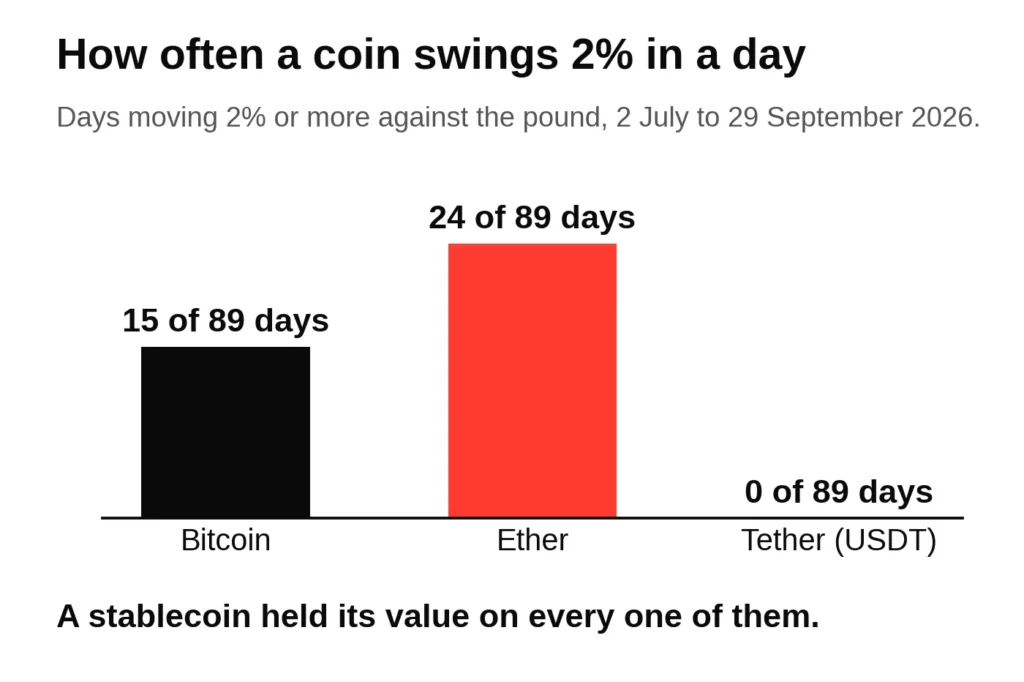
| Bitcoin | The most widely accepted. Moved 2% or more against the pound on 15 of 89 days in our sample, with a biggest single-day rise of 7.27% |
|---|---|
| Ether | Widely accepted and faster to confirm than Bitcoin. Moved 2% or more on 24 of 89 days, with one day up 16.95% |
| Tether (USDT) and USD Coin (USDC) | Stablecoins tied to the US dollar. Tether never moved 2% in a day; its median daily move was 0.13%, which is the dollar against the pound |
| Other coins | Litecoin and others are taken at some books. Check the network fee and the minimum withdrawal before you use one |
Crypto has a cost the card does not: buying the coin and selling it again. Exchanges charge a fee or a spread at each end, and the network takes a small fee to move it. We have not priced every exchange, so the chart assumes a 2% round trip to show the scale.
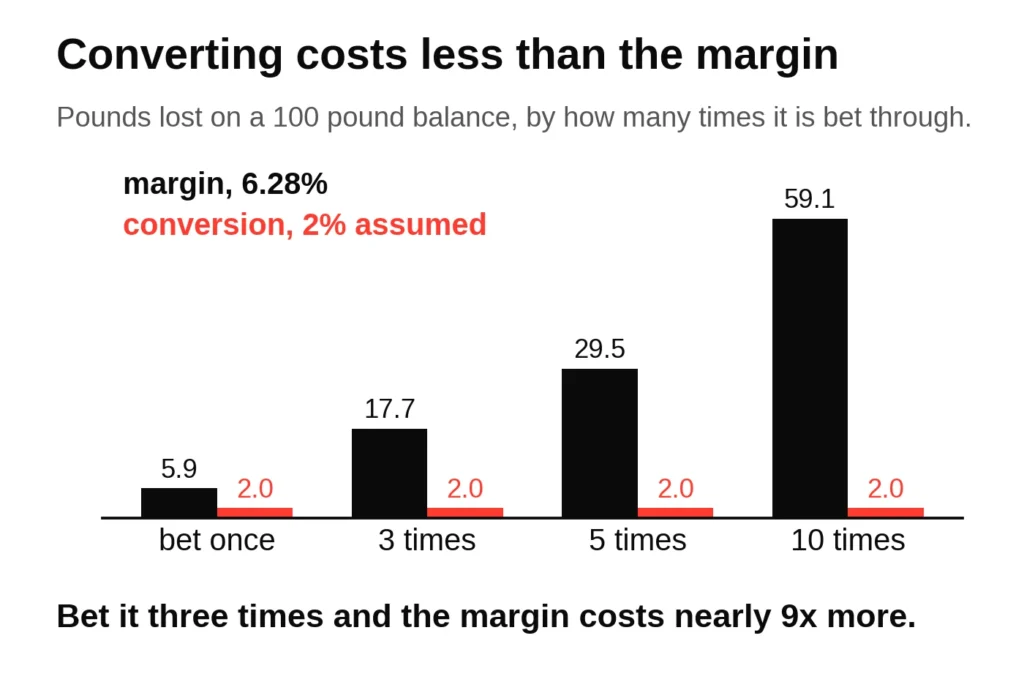
The margin arithmetic behind these figures is on our page about the overround, and the 6.28% average comes from our football betting sites dataset.
No KYC means betting without sending identity documents, and it is one of the main reasons punters look for crypto betting sites. At many offshore books you can deposit coin from your own wallet and bet straight away. What no KYC does not usually mean is never.
None of this is a UK rule. It comes from the book’s own licence and its payment partners.
Betting winnings are not taxed for individuals in the UK, and that does not change when the bet is placed in crypto. The coin is a different matter.

A stablecoin bought and spent at much the same value creates little or no gain, which is one more reason stablecoins suit betting.
Most books pay a withdrawal back to the method you paid in with, where that method can receive money. Planning the deposit around the withdrawal saves a delay later.

How long each method takes to reach you once a withdrawal is approved is covered on our fast withdrawal betting sites page.
| You want PayPal | That means a UK-licensed book, and its checks before your first bet |
|---|---|
| Quick deposits at an offshore book | A debit card or an e-wallet where the book takes them |
| A larger balance held at an offshore book | A stablecoin, so the balance keeps its value between bets |
| Betting without a bank on the statement | Crypto from your own wallet |
| A fixed amount and nothing more | A prepaid voucher, remembering it cannot receive a withdrawal |
Betting is legal in the UK, and so is holding crypto. A UK-licensed book may accept crypto only if it meets the Gambling Commission’s anti-money-laundering conditions, so many crypto betting sites used by UK punters are licensed elsewhere, often in Curacao.
Yes. Buy the coin on an exchange, send it to the deposit address the book gives you on the network it names, and bet once it arrives. Withdrawals go back to a wallet address you provide.
A stablecoin such as Tether or USD Coin, if you want your balance to keep its value. In our sample Bitcoin moved 2% or more against the pound on 15 of 89 days and ether on 24; Tether did not once.
Many offshore crypto books let you deposit and bet without documents, but they commonly ask at the first withdrawal or above a set amount. UK-licensed books verify you before your first bet.
Rarely. PayPal needs to approve a gambling business first and approves it only where the gambling is legal for both the book and its customers, which in practice means UK-licensed books for British punters.
Not at a UK-licensed book, which has been barred from taking credit card payments for gambling since 14 April 2020. Offshore books are not bound by that rule, but your card issuer may charge cash advance fees.
Betting winnings are not taxed for individuals in the UK. Spending a coin, including sending it to a book, is a disposal for Capital Gains Tax, so a coin that rose in value since you bought it can create a taxable gain.
Request a withdrawal in the cashier. Most books pay back to the method you deposited with, or to your bank if that method cannot receive money; a crypto withdrawal goes to the wallet address and network you give.